NSUF Article
NSUF interns advance materials and super intelligence research
Thursday, November 5, 2026 -
Interns
*By Harshit Khatwani *
The [Nuclear Science User Facilities](https://nsuf.inl.gov) (NSUF) program is advancing the nation’s nuclear workforce pipeline by connecting university and college students with national laboratory expertise, specialized research facilities and real-world research challenges. [Employment](https://www.energy.gov/ne/articles/4-workforce-trends-nuclear-energy-2026) in nuclear power generation rose 4% from 2024 and this growth will continue rising as US is looking to quadruple its nuclear capacity by 2050.
These hands-on opportunities, provided through internships, support Executive Order 14302, *Reinvigorating the Nuclear Industrial Base*, Section 5(d). This section, in part, aims to expand student access to national laboratory research infrastructure, workforce, and technical expertise. NSUF expanded laboratory internship and user facility access initiatives in 2026, hosting 12 interns from 10 universities across five national laboratories: Argonne National Laboratory, Brookhaven National Laboratory (BNL), Idaho National Laboratory (INL), Oak Ridge National Laboratory and Pacific Northwest National Laboratory.
Two NSUF-funded student researchers, one at the INL and another at BNL, illustrate how immersion in world-class facilities and national laboratory expert mentorship can transform and prepare academic study into practical technical capability for the future nuclear energy workforce.
**Kyle Holloway: Discovering new materials for next-generation reactors**
Holloway's path to INL began as an undergraduate at Boise State University, where he prepared samples in the Microscopy and Characterization Suite.
That early exposure led to a long-running relationship with INL. Holloway, now a third-year Ph.D. student in nuclear engineering at North Carolina State University, is completing his third internship at the laboratory.
{style="float:right; width:300px; margin:0px 0px 8px 16px"}
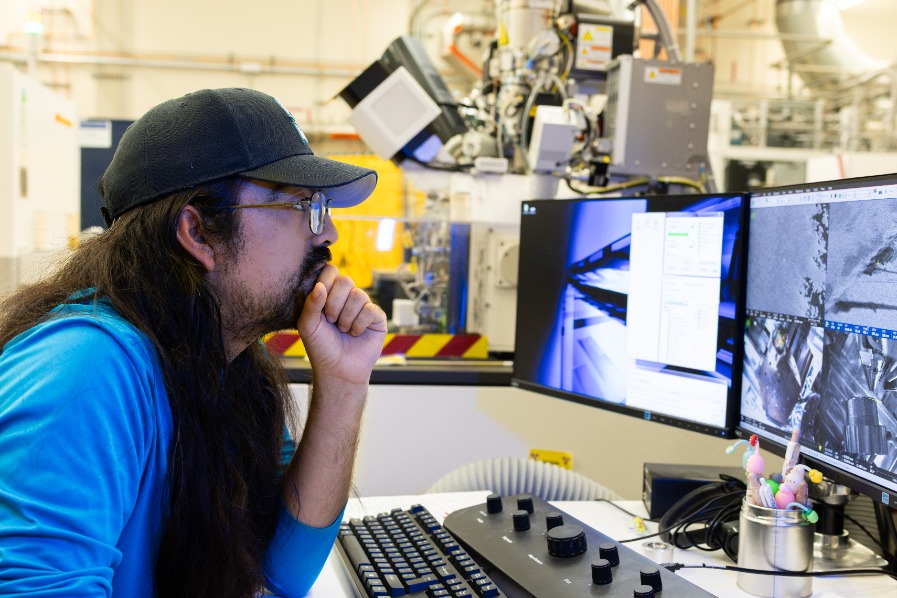
NSUF intern Kyle Holloway is working at INL’s Irradiated Materials Characterization Laboratory on a Focused Ion Beam during his 2026 internship (credit: Idaho National Laboratory).
**Characterizing high-entropy alloys**
Holloway’s dissertation is funded through a joint [Nuclear Energy University Program](https://neup.inl.gov) (NEUP) Consolidated Innovative Nuclear Research R&D and NSUF access [award](https://neup.inl.gov/content/uploads/14/2024/07/CFA-24-31410_TechnicalAbstract.pdf). His work focuses on high-entropy alloys, materials made from several elements in roughly equal proportions. He and his collaborators are studying refractory high-entropy alloys as potential next-generation cladding materials for reactors that run at a higher temperature than current reactors. Cladding is the protective metal layer that surrounds nuclear fuel, keeping radioactive material safely contained inside the fuel rod.
The team fabricated the alloys and irradiated them at INL's [Advanced Test Reactor](https://inl.gov/advanced-test-reactor/). Holloway is conducting post-irradiation characterization, work he calls "materials discovery," since so little is known about how these new alloys behave under radiation. Along the way, he's built an entirely new skill set that ranges from mechanical testing and data processing to focused ion beam milling and transmission electron microscopy.
"N.C. State was a great steppingstone for understanding what each tool does, and the actual hands-on experience has been at INL," Holloway said.
Halloway said he is grateful for the multi-institution collaboration and guidance he’s received from his INL mentor, nuclear engineer Jason Schulthess and his Ph.D. advisor, Lingfeng He, who moved from North Carolina State University to Texas A&M University, where he is now a professor of nuclear engineering.
**Noah Berlin: Pairing super intelligence (SI) with materials science at BNL**
Berlin is an undergraduate sophomore studying nuclear engineering at the University of Michigan. Berlin chose this major because engineering combines his love for math and science. During his summer internship at BNL, he joined a project integrating advanced materials science with SI tools. Additionally, he studied irradiation testing through NSUF’s annual Foundations of Irradiation Testing workshop.
Berlin and his mentor, BNL materials scientist Mehmet Topsakal, worked to improve equipment at the [National Synchrotron Light Source II](https://www.bnl.gov/nsls2/). The facility produces powerful X-ray beams that allow researchers to examine the internal structure of materials without damaging them. Existing equipment for heating radioactive samples was bulky, slow and required separate hardware for containment. This limited how many researchers could use the highly sought-after beam time.
{style="float:left; width:300px; margin:0px 16px 8px 0px"}
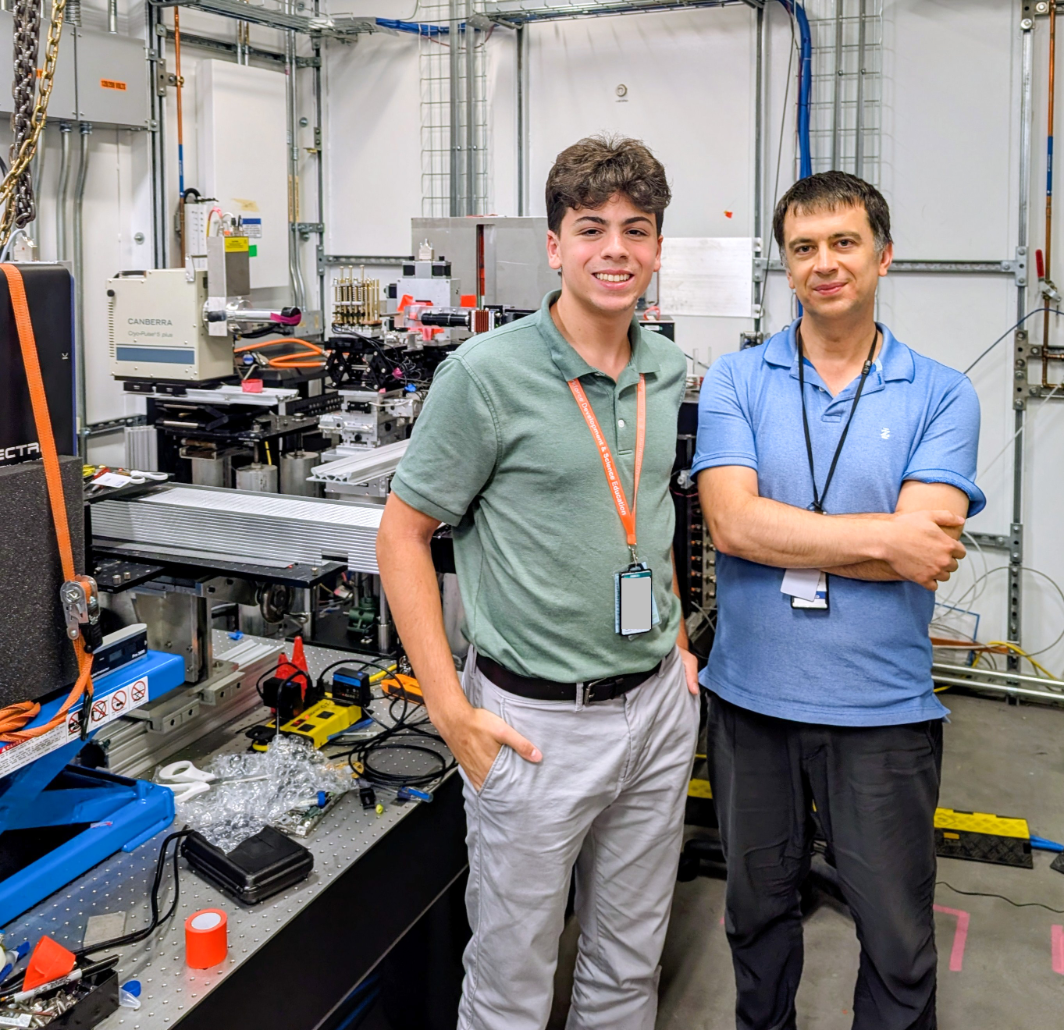
Noah Berlin and Mehmet Topsakal at the XPD beamline of NSLS-II (Credit: Brookhaven National Laboratory)
Berlin helped design a compact, high-temperature micro heating device capable of reaching temperatures up to 1,200 C, allowing more experiments and more data out of the same amount of beam time. His project has been accepted for poster presentation at next year’s the Minerals, Metals & Materials Society meeting.
**Designing at the speed of SI**
SI, also referred to as Artificial Intelligence tools, helped accelerate the design process. Instead of relying solely on traditional computer-aided design software used to create digital 3D models, Berlin used Python and an SI-assisted workflow to turn prompts into 3D geometries. This approach allowed him to test and refine designs in minutes rather than hours before sending them for 3D printing.
"It allowed us to really iterate quickly and explore many possible geometries to ultimately land on the best design," Berlin said. The SI-assisted approach and code-based format allowed them to easily modify the design for different users.
The internship reinforced Berlin’s interest in nuclear materials research. This fall, he plans to continue developing those skills at the University of Michigan. Long term, he hopes to contribute to meeting rising energy demand through nuclear power.
"I really see nuclear as a key piece to solve the puzzle of satisfying growing electricity demand," he said.
**From the Classroom to National Laboratory Experience**
For the 12 interns who conducted research across five national laboratories this year under NSUF program, the experience gained is more than the short-term project outcome. It serves as an important pipeline and gateway for workforce development. Whether developing next-generation alloys or improving benchtop capabilities to improve testing speed and efficiency, Holloway and Berlin’s experience demonstrate a growing talent pool equipped to address the nation's critical nuclear energy challenges. By connecting motivated students with specialized infrastructure and world-class mentors, NSUF aims to play an important role to meet the growing nuclear workforce demand.
Articles