NSUF Article
User Facilities Help Develop the Next Generation of Nuclear Researchers
Wednesday, September 9, 2026 -
RTE, Program Office Highlight, Researcher Highlight, Nuclear Research
{style="max-width: 100%; float:right; width:321px; margin:0px 0px 15px 15px;display:none;"}
By Paul Menser
{style="float:right; width:300px; margin:0px 0px 8px 16px"}
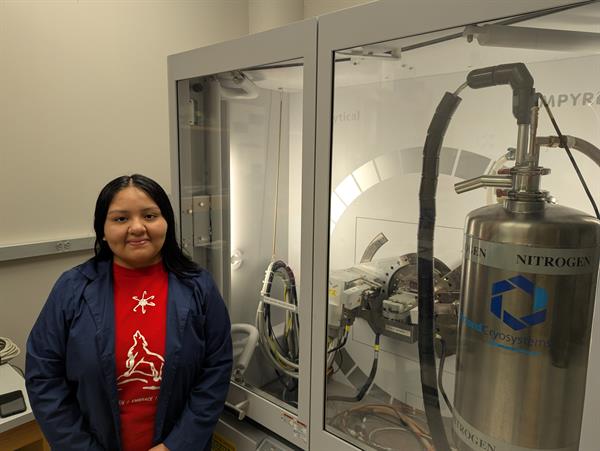
As a research scholar at the Analytical Instrumentation Facility at NC State, Lucia investigates the solid-state synthesis of dielectric materials via in situ high-temperature X-ray diffraction experiments (Credit: Analytical Instrumentation Facility).
As the United States nuclear research community continues to develop its talent pipeline, it can look to students like Lucia Rebeca Gomez Hurtado as a sign that the outlook is quite bright.
Likewise, the resources for supporting students like Gomez Hurtado are better than ever. She earned a doctorate from North Carolina State University in May and has since taken a research scholar position at the school’s Analytical Instrumentation Facility. Mentored by faculty advisor Ge Yang, Gomez Hurtado pursued her Ph.D. research through projects supported by the Nuclear Science User Facilities (NSUF), which provided valuable opportunities for hands-on research at Argonne National Laboratory and Idaho National Laboratory.
Her thesis, "Irradiation Effects on Gallium Oxide: From Sample Preparation to Microstructural Characterization," investigated the structural, chemical and mechanical behavior of gallium oxide under extreme conditions.
After Gomez Hurtado joined Yang’s research group, he introduced her to gallium oxide research and guided her toward investigating its potential for radiation detection and extreme-environment applications. She subsequently devoted her Ph.D. research to studying the material’s behavior under irradiation, providing important insights into its resilience under conditions that can degrade conventional electronic materials. Support from the NSUF facilities through Rapid Turnaround Experiments, particularly access to advanced research, played an important role in her ability to pursue this work.
**Watching radiation damage in real time**
As part of the broader research effort, Yang’s team exposed gallium oxide samples to neutrons for periods ranging from a few hours to 300 hours and characterized the resulting damage using positron annihilation lifetime spectroscopy (PALS) and complementary microstructural techniques. In PALS, positrons become trapped in microscopic vacancies created when radiation displaces atoms from their normal lattice positions. The measurements revealed irradiation-induced changes in the material’s vacancy-related defect structure.
{style="float:left; width:400px; margin:16px 16px 16px 0px"}
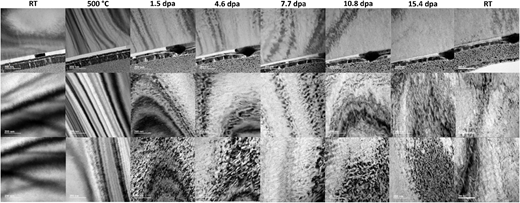
Real-time TEM images capture gallium oxide's defect evolution under combined heat and ion irradiation, from early-stage damage to complex dislocation networks. (Credit: ACS Applied Materials & Interfaces, 2025).
Gomez Hurtado’s primary contribution focused on in situ transmission electron microscopy at the Intermediate Voltage Electron Microscopy facility at Argonne National Laboratory, with valuable technical guidance and support from scientists at the partner facility. She and fellow Ph.D. student Chris McRobie directly observed the evolution of radiation damage in gallium oxide during charged-particle irradiation, including experiments conducted at temperatures as high as 800 C. They observed the damage first appearing as tiny dark spots that subsequently grew and merged into larger defects, including dislocations — distortions in the material’s otherwise orderly atomic structure.
Rather than relying solely on comparisons made before and after exposure, this in situ approach allowed the research team to directly track how defects formed and evolved during irradiation. One of the most notable findings was that gallium oxide underwent a structural transformation when irradiated at room temperature. The transformation was suppressed at elevated temperature, which appeared to promote defect recovery and help stabilize the material’s crystal structure. Even under substantial irradiation damage, the material remained crystalline rather than becoming amorphous — a common failure mode in many other materials. That ability to remain crystalline under irradiation could make gallium oxide a strong candidate for sensors that must operate in radiation-intensive environments.
**Rapid Turnaround Experiments and national laboratory experience**
With guidance from her PhD advisor, Gomez Hurtado gained valuable experience developing proposals to secure access to specialized facilities and experimental resources. This experience strengthened her proposal-writing skills and connected her with a broader network of national laboratory scientists and collaborators.
Gomez Hurtado completed two internships at the Idaho National Laboratory, receiving valuable exposure to applied nuclear materials research in a national laboratory environment. Working with previously irradiated HT9 steel samples provided by her internship mentor, she helped develop an innovative methodology for preparing transmission electron microscopy specimens for small-scale mechanical testing. Such hands-on experience in preparing and characterizing irradiated materials is relatively uncommon for graduate students.
During one of her INL internships, Gomez Hurtado contributed to the proposal writing and was successfully awarded a NSUF Rapid Turnaround Experiment project as a principal investigator. Together, these experiences strengthened her technical and proposal-development skills, supported her doctoral training, and broadened her understanding of how advanced materials research is conducted to address nuclear energy challenges.
**Workforce development**
Gomez Hurtado said that her research experiences at INL and Argonne National Laboratory were transformative for her professional development. Working directly with advanced characterization tools and national laboratory scientists sharpened her technical expertise, confidence and independence as a researcher. “I got to polish my skills and grow as a scientist,” she said.
Yang emphasized the importance of students seeing researchers like Gomez Hurtado succeed and advance professionally. He described her as an effective collaborator who works well across research teams, engages colleagues constructively and takes increasing ownership of complex scientific work. Yang noted that, as Gomez Hurtado continues to grow as a researcher and scientist, she is also steadily developing into a strong scientific leader.
Experiments using advanced characterization tools can generate large amounts of complex data, creating opportunities for new approaches to data analysis. Gomez Hurtado hopes to see greater collaboration across disciplines as AI and machine learning become more deeply integrated into materials research.
“With the ability to analyze data faster, we can improve data collection and increase throughput with a lot more precision,” she said. These tools could help researchers interpret complex experimental data more efficiently, uncover subtle patterns and accelerate scientific discovery.
Yang also noted growing interest in nuclear engineering, particularly among undergraduate students. “They want to learn more,” he said. “It’s a very exciting time for the nuclear community.”
Articles